Blue: the colour of the unattainable
Some ideas don’t arrive as thoughts. They arrive in moments.
The sea changed without effort. Light moved across its surface, the wind passed through it, and the colour held everything together — a vast, continuous blue that felt less like something observed and more like something entered.
Perhaps blue is the colour of the unattainable.
Not because it is distant, but because it begins where we stop being certain. The sky rests on nothing. The sea never stays still long enough to be fixed. And even the horizon shifts the moment we try to hold it. And yet it is everywhere.
Blue holds our attention differently. It doesn’t pull it forward or scatter it. It steadies it, just long enough for everything else to fall away — not into emptiness, but into space. I didn’t feel separated from the world. I felt briefly less divided from it.
Calm is too simple a word. It was closer to expansion, as though the boundaries of thought had softened and I was no longer standing opposite the world, but within it.
Perhaps this is why blue is associated with stillness and reflection — not because it is passive, but because it slows perception into something more receptive, where meaning is not forced but allowed.
And yet blue is never only calm. It carries an emotional depth that does not resolve. It can be both peace and longing at once — something held, something just out of reach — without choosing between them. This is why it feels human.
We are not single emotions. We are overlapping states that rarely align cleanly: clarity and doubt, calm and unease, sometimes within the same moment. Blue does not simplify this. It reflects it.
Anyone who has stood by the sea knows this. It is never the same twice. Some days it feels almost attentive; others it makes you quiet without explanation. What changes is not only the water, but what it draws out of you. Something in us responds before language arrives.
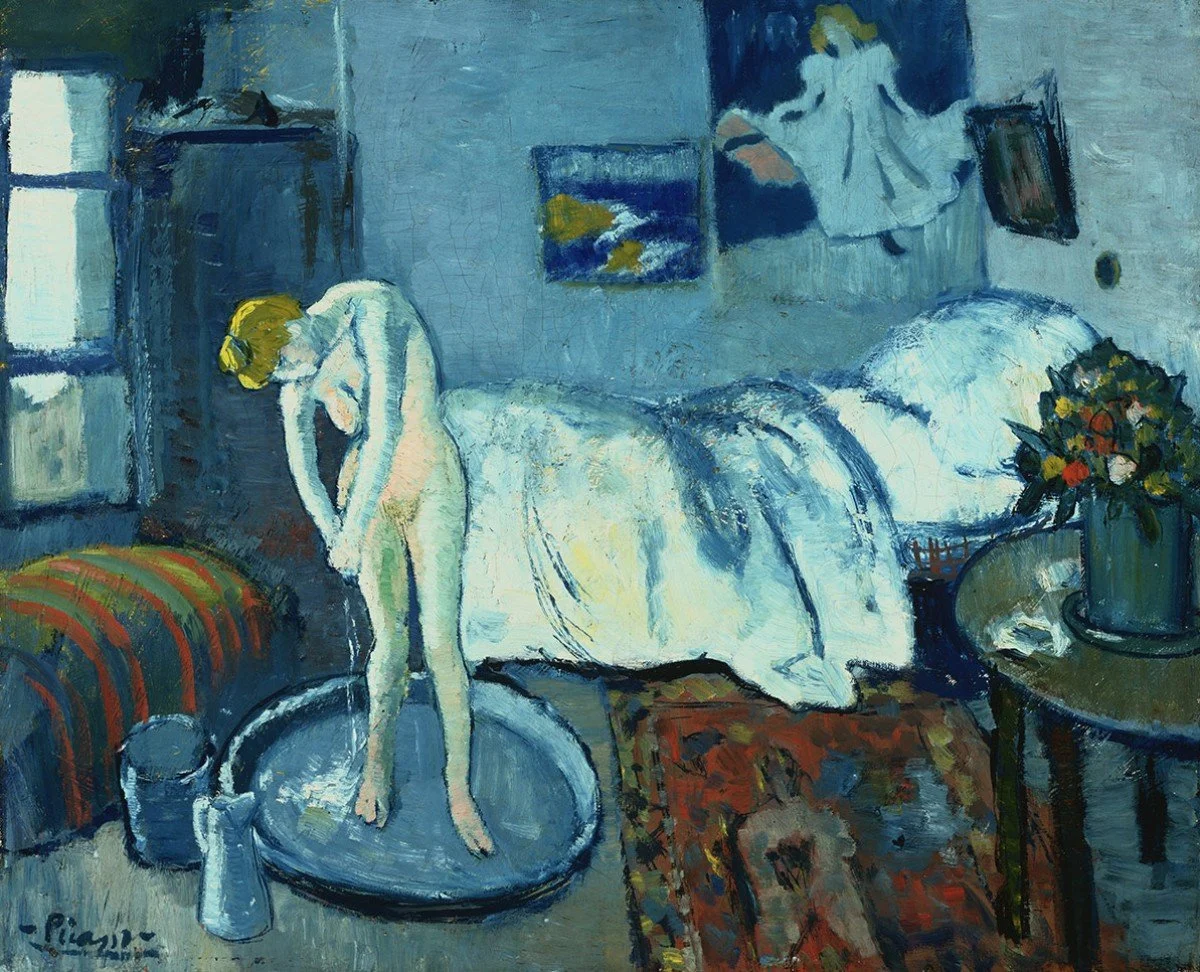
Perhaps this is why artists return to blue again and again. During his Blue Period, Picasso turned it into a language for solitude and loss, but also for tenderness and recognition — not because blue means sadness, but because it can hold sadness without breaking it apart. Other artists have found something else in it entirely: distance, clarity, stillness.
Nothing in blue can be possessed. The sky cannot be held. The sea cannot be kept. Even the horizon shifts as we move toward it. Blue resists possession not by disappearing, but by refusing to become fixed.
Perhaps what I understood that morning was simple: what matters most is not what can be grasped, but what we can be within.
Looking back, I don’t think I was moved by blue because it explained anything. I think I was moved because, for a while, it suspended the need for explanation altogether. It made space for something quieter than understanding. Something closer to recognition.The feeling of not being separate from what I was seeing.
Only part of it.
And perhaps that is what blue offers: not answers, but a brief release from the need to resolve everything.
Blue is not merely a colour. It is what remains when we stop trying to hold the world still.